Piedmont · October
Piedmont, When Autumn Settles In
October settles slowly over Piedmont. The vineyards are turning, the last of the harvest is coming in and, beneath the woods around Alba, the white truffle has returned.
Piedmont · October
October settles slowly over Piedmont. The vineyards are turning, the last of the harvest is coming in and, beneath the woods around Alba, the white truffle has returned.
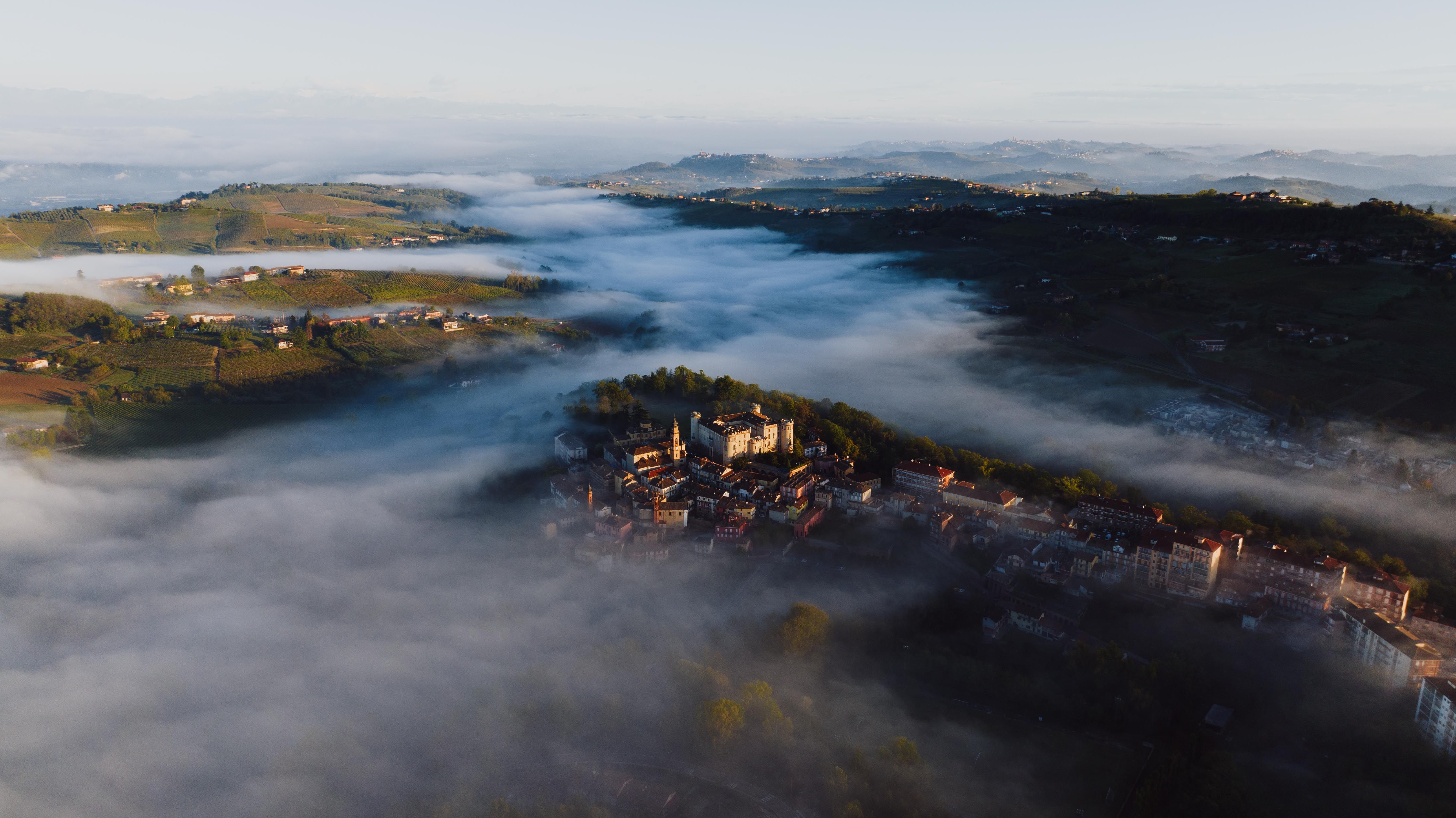
From above, Piedmont seems to gather itself around the hills. Vineyards follow their contours in narrow lines, climbing towards villages that sit high above the valleys. Castles and church towers interrupt the ridges. Beyond them, on a clear day, the Alps hold the horizon.
In October the landscape begins to change without becoming bare. Green remains in the lower ground, but the vines have started through yellow towards copper and red. Mornings arrive cooler. Mist gathers in the folds between the hills before lifting, and the light that reaches the vineyards later in the day has lost the hardness of summer.
The harvest is drawing to an end. In the Langhe, where wine has shaped the land as visibly as any road or building, the last grapes are brought in and the work moves gradually from vineyard to cellar. October sits at that point between abundance and rest: barrels filling below ground while the slopes above begin to quiet. The grape harvest here traditionally runs from the end of summer into the beginning of October.
Piedmont means at the foot of the mountains, but the part of it around Alba is a country of smaller elevations: folds of vineyard, woodland and cultivated land repeating into the distance. Food follows the same geography. Wine comes from one slope, hazelnuts from another, cattle from the farms between them. And in autumn, something far less visible begins to matter.
The white truffle does not announce itself. There is no fruit hanging from a branch and no colour in a field to show that it is ready. Tuber magnatum Pico develops underground, associated with the roots of certain trees, and finding it belongs to the trifulau and the trained dog that works beside him, the tabui in Piedmontese. They move through woods that can look entirely ordinary until the dog stops and begins to dig. The tradition of searching for truffles depends on knowledge of soil, trees, weather and season passed through generations.

What comes out of the earth is not especially beautiful. A white truffle is irregular and pale, sometimes no larger than a walnut, sometimes considerably bigger. Its importance becomes clear only when it is cut.
The perfume is immediate.

That is why the cooking around it tends towards restraint. Tajarin — the fine, egg-rich pasta of the Langhe — needs little more than butter before white truffle is shaved over it at the table. Eggs offer another quiet background. So does risotto. Raw Fassona beef, dressed lightly, becomes something else entirely when a few thin slices fall across it.

The truffle is not there to disappear into the dish. The dish exists, in part, to allow the truffle to remain itself.
Alba makes a public celebration of what the woods have produced. From October into December, the White Truffle World Market brings hunters, traders, cooks and visitors into the old centre of the city; in 2026 it opens on 10 October. Truffles are inspected, weighed and sold alongside the wines and foods of the surrounding Langhe, Roero and Monferrato. But the pleasure of October is not confined to the fair. It is present whenever someone leans over a plate of warm tajarin while another person shaves a truffle above it and the aroma reaches the table before the first fork has been lifted. There are few ingredients for which anticipation is so much a part of the taste.
The rest of the Piedmontese table does not need to compete with it. Agnolotti del plin arrive small and folded, their name taken from the pinch used to close the pasta around its filling. Carne cruda is cut finely and served with the kind of restraint that makes the quality of the beef impossible to hide. Vitello tonnato brings together thin veal and the savoury richness of tuna and capers in a combination that belongs so completely to Piedmont that its apparent contradiction no longer seems unusual.
As the evenings cool, the food becomes deeper. Slow-cooked beef and red wine belong naturally to a region where Barolo and Barbaresco are made a few hills apart. Hazelnuts find their way into cakes, creams and chocolate, though a roasted Piedmont hazelnut needs very little done to it. A meal can finish with something sweet, or simply continue around the remains of the wine.

And the wine matters here in a way that goes beyond pairing. Vineyards are the landscape. Nebbiolo, Barbera and Dolcetto do not arrive at the table as an embellishment to Piedmontese food; they come from the same hills that determined the food in the first place. A bottle opened in October contains other years and other harvests, while outside the window another one has only just finished.
That compression of time is part of what makes autumn in Piedmont particular. One season is being gathered in while another is beginning underground. By late afternoon the mist has usually gone. The hills become sharper, then softer again as the sun falls behind them. Villages appear as silhouettes along the ridges. Lights begin to show in the houses and restaurants above the vines.
Dinner need not be complicated.
Warm pasta. Butter. A truffle brought in from the woods that morning. Beef cooked slowly enough to surrender to a fork. A bottle whose vineyard may be visible from the table. October has already supplied most of what is required
The pleasure of these flavours is that they are difficult to separate from their season. White truffle in spring would lose some of its meaning. Tajarin beneath a summer sun would still taste good, but it would tell a different story. Here, the cooling air, the finished harvest, the woods and the food seem to be moving at the same pace.
That is what remains after a place has been left behind.
The precise line of a vineyard may disappear from memory. The names of the villages may begin to overlap. But butter warming beneath shaved truffle, the richness of egg pasta, hazelnut and red wine can recover the atmosphere surprisingly quickly. A flavour arrives first and the rest follows: mist between the hills, leaves turning in the vineyard and October light fading over the Langhe.
For a moment, Piedmont is not quite so far away.

Piedmont need not remain behind simply because the journey has moved on. For travellers who wish to carry something of its autumn with them, Velair Privé creates bespoke inflight menus shaped by place, season and memory.
Costigliole d'Asti - K / Pexels
Curious Dog - Andreas Schnabl / Pexels
Sliced Truffles - Valeria Boltneva / Pexels
Fresh Pasta - Antonius Ferret / Pexels
Red Wine Dinner - Natalia Goryaeva / Pexels
Castiglione Falletto - K / Pexels